For close to three decades now, the people of Assam have been held to 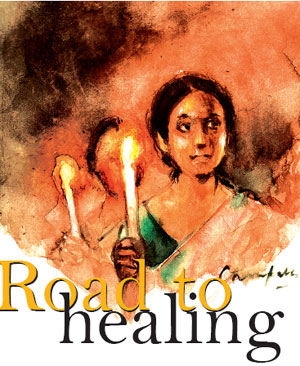 ransom by the forces of terror. And Black Thursday seemed a culmination of a horrendous tragedy. As shards of glass, twisted metal, black smoke and fiendish flames lit up our television screens, we were benumbed by the sight of the dead and the dying. So long, we thought a tragedy of this magnitude could happen only in cities far from us, but now, death had come riding, plucking, as it were, anybody at will. The days that followed have seen a spontaneous outpouring of grief and outrage. While some sought to burn effigies and destroy public property, the majority led symbolic protests and lit candles for peace and closure. Yet others have flocked to hospitals to donate blood, visited homes to adopt orphans or render any kind of help. The glimmering candles, the images on canvases, the floating of paper boats on the Dighalipukhuri – all point to the divine and peaceful ways people are coming to terms with a tragedy of this magnitude.
While this tragedy affects all, it is especially difficult for young children. There are unanswered questions that impinge on their impressionable minds. They ask themselves – How can I be safe? How can anyone hurt little children? How can I be sure this won’t happen to me and my loved ones? Who would do such a thing? Why? What can I do? This scenario is doubly difficult when their parents can give them no assurances.
But there are things that parents can do to retain the equilibrium of their children. In the initial hours and days, shield children from violence by enclosing them in a cocoon of family safety and warmth. Relax your usual routine and disciplinary standards to offer your children extra affection, protection and time together.
It is usual to have some signs of stress for hours, days, even weeks. It is normal to go through an unfamiliar numbness, intense vulnerability, anger, fear, nightmares, poor sleep, memory and concentration. But, it would do good to remember that things have their beginning, middle and end. Things can improve, especially if you yourself will them to, for yourself, your loved ones and the community.
In the aftermath of the tragedy, it has been seen that many people repeatedly tune onto the horrific images on television. People must step back and ask themselves: “What am I achieving by doing this? Am I learning anything new?” A good way to avoid this would be to seek the company of other people, and the best way to heal is to pitch in and help those who have suffered.
I have seen that many people tend to protect their children by refusing to discuss the issue of terrorist attacks. This can lead to greater fear and insecurity. Mental health workers maintain that we must be honest in answering questions, but also be firm in not allowing the young to dwell on the issue. It is a good idea to get back to the soothing tempo of everyday routine.
At a time like this, when precious human lives are lost, it is easy for everyone to slip into cynicism and despair. This is understandable, but to brood indefinitely over what has happened will only worsen matters. If you are a parent, it is very important to highlight that there are good people at hand, people who have gone to the aid of strangers irrespective of the danger involved, people who have donated blood, spent time with those injured or in mourning, or even gone ahead to adopt an orphan child. Conversations about such good deeds will help raise levels of hope and optimism in us for the future.
While this horrifying experience of terrorism was seen on our city’s streets, another was beamed through television channels. People would say this is a tragedy of far lesser magnitude. But it underscores the barbarian cruelty that seemingly ordinary people inflict on a helpless victim. Here she is a young maid servant forced to work as a domestic help to fend for herself and a blind father. Her owners, a young couple with children of their own, subject her to daily torture in an effort to handle their own “professional stress”. She was beaten, burnt with a hot griddle, and subjected to every kind of punishment in an effort to what her employer says was “to make the girl speak the truth.” Neighbours, haunted by the girl’s screams, informed the National Commission for Women, which led to their arrest. What is macabre is that the lady had actually captured a punishment session on her mobile phone. One imagines that this bar- baric woman loved to relive these torture sessions by watching those images whenever her boss ticked her off.
Do these incidents reveal that man is innately violent in nature, and that there is no hope? No, that is not the case. We are capable of great love and concern for each other. There is a nobility in us that prompts us to rise above differences, and build bridges of peace and understanding. In our schools, colleges and universities, there must continue to be a strong focus on spiritual learning. Instead of the aspirationals nature of our lives, educators must lay stress on the inspirational dimension that we are capable of. We must believe that the innate goodness in us is strong and that we can only overcome our many setbacks if we work together towards one goal – that of peace and a just social order.
i_raimedhi@yahoo.co.in
Indrani Raimedhi